We welcome article submissions from experts in the areas of coal, mining,
shipping, etc.
To Submit your article please click here.
|
|
|
Tuesday, 13 September 11
CAPITAL COSTS OF INDIAN COAL MINING PROJECT - AN ANALYST VIEW
.jpg) By Mr Dipesh Dipu, Director - Consulting (Mining), Deloitte Touche Tohmatsu India Private Limited By Mr Dipesh Dipu, Director - Consulting (Mining), Deloitte Touche Tohmatsu India Private Limited
The coal mining sector that has been opened partially through captive mining route has seen allocation of 208 coal blocks to private sector, government-owned power generation and other downstream companies. These coal blocks, however, have had limited success in terms of operationalisation on time and at budgeted costs. These have led to serious concerns for coal supplies for power generation sector in India.
One of the key concerns for the development of the coal mines in India has been the quantum of capital required which is the determinant of expected returns from investment perspective and the viability of the project in terms of affordability of power so generated. The capital costs for coal mining projects typically include costs of land, capital equipment and infrastructure to support mining and logistics. Project costs also include capitalised expenses for clearances and approvals that help the mining project take off.
Elements of Capital Costs
Cost of land typically means the cost of acquiring surface rights for coal bearing land for which allocation has been made by the appropriate authority. The recent social concerns that have generated a lot of debate in the country centre on the cost of land which the companies are willing to pay for acquiring surface rights. The recent trends indicate that the land values head northwards since the time of announcement of a project, which makes it challenging to estimate the cost of land. In states that have vast coal resources, the land acquisition issues have been observed to be acute. In Talcher and IB Valley coalfields of Orissa, for example, there are a large number of coal blocks proposed with massive capacities. In these coalfields, it may therefore be expected that land costs will be relatively higher for the coal mining projects. Costs of mining equipment largely dominate the project costs, although due to higher costs of land acquisitions, its proportions are likely to be revised downward. The costs of equipment, typically, are functions of geological characteristics, technology, mine design and requirement of coal processing. Equipment costs also include costs of electricity supply features, drainage systems, environmental management systems, surveillance systems and several others. The costs of construction of coal handling plants and railway siding are parts of support systems for evacuation of coal and if the coal project is relatively farther from the nearest railhead, the costs will be higher. For pit-head power project, the costs include the conveying system from mine to the coal handling system of the power project.
Key Determinants of Capital Costs
Technology is a key determinant of capital cost. Underground coal mining and surface (or opencast) mining has different requirements. In the underground mining methods, there are variants such as bord and pillar, longwall, shortwall and variants for thick seam mining such as horizontal slicing and inclined slicing; sub-level caving and others. The accesses to coal seams are made either through inclines (surface drifts) or vertical shafts, each of which may have substantially different capital cost. In surface mining methods, equipment selection largely determines the project costs - shovel-dumper combinations, dragline, bucket wheel excavators are mostly used in India. The geo-technical parameters like dip and strike length, inclination of seams, thickness of overburden layer, and stripping ratio are indicators of specifications of equipment required, which, in turn, indicate the capital costs.
Equipment selection, therefore, is at the core of the determination of capital costs. In surface mining, the equipment selection takes into account the geological features such as partings between coal seams and expected bench heights. These impact the selection of size of shovels and matching dumper sizes. In such cases, the natural economies of scale need not work and hence, the capital costs per tonne of production versus capacity or size of excavators is a non-linear function.
Apart from the excavators and hauling equipment, capital cost of surface mines also depend on size and number of drilling machines, which, in turn, are dependent on the hardness of the rock. For blasting, the use of site mix slurries or site mix emulsion explosives can eliminate the need to maintain a magazine at mine project and thus, lower the capital costs. Relatively softer rock formation, such as those of lignite, the drilling blasting processes may be replaced by continuous mining system as bucket wheel excavator. Rock fragmentation and the requirement of crushing (including secondary crushing and sizing) will determine the additional equipment required that have a direct bearing on capital costs.
Hydrological characteristics of mine indicate the requirement of drainage and pump capacities. These may be significant where the water tables are high and may have large capital costs required to keep the working faces prevented from being inundated.
Estimates
According to estimates, investments needed in surface coal mining in India are in the range of INR 1500-2100 (approximately US$ 31.65 - 44.30) per tonne of rated capacity. For example, investment in a one million tonne per annum capacity mine is expected to be INR 210 crore (approximately US$ 44.295 million). This estimation is based on a stripping ratio of 4:1 and appropriate adjustments can be made for projects that have higher or lower stripping ratios. This, however, is as good as only an estimate and for the purpose of evaluations and investment decision making purposes, nothing can substitute a detailed plan, including equipment selection and fleet size determination.
For underground mining, the estimates are in the range of INR 1900-2800 (approximately US$ 40.07 - 59.05) per tonne of rated capacity. These are estimated for project that are shallow (within 150 meters depth) and are worked with semi-mechanized bord and pillar mining methods.
Business models change contribution to capital costs
At a high level, project costs remain more or less unchanged, irrespective of ownerships and financing pattern. However, for the project developers, the project costs are not nearly as significant parameters as are the equity investments and returns thereof. The business models now being contemplated and implemented substantially reduces the equity investment and causes the owner of the coal mine to focus on alternative investments such as, those in power generation capacity building. Contract mining is fast catching up in India as the preferred mode for development and operations of mines. The business model of hiring contract mining companies for overburden removal and even mineral winning is not a recent innovation. There are a number of new projects being planned through contract routes. Even the traditional mining companies like, the Coal India Limited and SCCL have been contracting out their mining operations. The scope of work in many cases involves the contract mining company to use their own equipment to carry on mining activities, which reduces the capital expenditure requirement of the coal mine owner.
In a total outsourcing model, the owners contract out all the processes including statutory approvals and clearances, land acquisition, mine development and operations. The recently floated tenders of a few state government owned power utilities are proponents of this model. The prospective bidders for the contract mining projects are expected to conduct their own geo-technical assessments, study the feasibilities and bid for the long term contract. The owner pays for all of these as the coal is mined and delivered to the owner. This model reduces the capital expenditure required by the owner for the coal mine development to nearly negligible.
Other business model is that of equipment leasing, which reduces the initial capital cost substituting the same by a more manageable lease rentals. The finance and operating types of leases help the mining project to have substantially lower cash outflows at the beginning of the project and help match the revenues with the costs when the mine starts the production of coal.
Capital Cost Management
Costs form a part of the decision-making process and cannot be used as a stand-alone decision-making tool. For this reason, there are several frameworks that can be used as a decision-making tool for surface and underground mining projects. These frameworks incorporate thinking obtained from viewing costs as a holistic entity. Strategic Cost Management (SCM) provides the thinking behind viewing costs as a strategic issue. Life Cycle Costing (LCC) suggests making use of the Net Present Value (NPV) approach to account for the use of the capital equipment. The LCC approach incorporates a tool into the framework that ensures that the cost of technology (capital) is accounted for over its lifetime.
Costing is the processing of expenditures to calculate their cost to each project. A typical and an ideal cost management profile is given below:
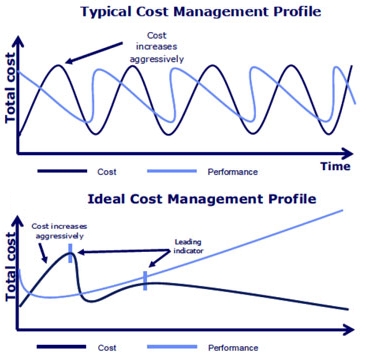 |
As costs increase, performance gets impaired. When cost reduction is periodically initiated, it often results in a temporary cull of capabilities, directly impacting on future ability to deliver performance. Where cost reductions are achieved, performance often recovers temporarily, only for focus on proactive cost management to be lost, and for costs to begin to increase again. Without specific cost management action, this cycle can continue indefinitely.
It must be observed that the ability to influence project success and enhance value is greatest at the start of project evaluation and rapidly declines as a project advances towards implementation. In the same instance, the cost of change dramatically increases throughout each project evaluation stage. This suggests that the quality of the decision making in the early stages of project evaluation, primarily focused at capital costs, is critical to an optimal project outcome.
Cost Escalations and Indices
In coal mining projects, capital costs are dynamic and are inflated when the projects get delayed. Cost indexes provide a means of adjusting out-dated capital and operating cost information for the effects of inflation due to such delays. They are based on statistical averages of costs for specific items and time periods. There are the composite indexes for capital and operating costs for each of surface and underground coal mining and coal processing (preparation) operations, which are calculated taking into account several projects done in the past as well as taking economic indices into account. Indexes for specific cost centres, e.g., labour, equipment, transportation, fuel, explosives, tires, electric power, natural gas, and industrial chemicals are available, which are being used by the industry and the regulators to allow prudent escalations in the capital and the operating costs.
The above analysis was originally published on Infraline.
The views and opinions / conclusion expressed on this analysis is purely the writers’ own.
About Dipesh Dipu
Dipesh Dipu works as Director with Deloitte in the Energy and Resources consulting practice of the firm and anchors the Firm’s initiative in the mining and metals sectors. He is a mining engineering graduate from Indian School of Mines and is a Chartered Financial Analyst (CFA).
He has also done executive program in business management from Indian Institute of Management Calcutta. Dipesh has recently been awarded the Abheraj Baldota Gold Medal for the Young Mining Engineer of the Year 2007 by the Mining Engineers’ Association of India in recognition of his contributions in the improvement of mining industry in India.
If you believe an article violates your rights or the rights of others, please contact us.
|
|
Saturday, 15 October 11
BUNKER PRICES AND DEMANDS PUSHED FREIGHT RATES UP - VISTAAR
COALspot.com - The market continued to be firm with all segments moving up with biggest gain in Handy size segment up by 15 pct. The BDI was u ...
Saturday, 15 October 11
BENGAL COAL IMPORT TEST - THE TELEGRAPH
The Telegraph reported that, the power position in Bengal improved today but alarm bells are ringing over imported coal stocks that are running out ...
Friday, 14 October 11
CAPE DERIVATIVES MARKET HAS NOT REFLECTED OWNERS´ EXPECTATIONS' - FEARNBULK
Handy
The Atlantic market continued its upward trend, with fresh cargo entering the market. Skaw Passero to US Gulf climbed US$ 1500 from la ...
Friday, 14 October 11
ADARO BUYS SERVO MEDA FOR RP200 BIO - INSIDER STORIES
Insider Stories reported that, PT Adaro Energy Tbk (ADRO) announced that its subsidiary PT Alam Tri Abadi (ATI), acquired 35% stake in PT Serv ...
Thursday, 13 October 11
DRY BULK MARKET’S RALLY CONTINUES, BUT ANALYSTS WARN IT WILL BE SHORTLIVED - NIKOS ROUSSANOGLOU, HELLENIC SHIPPING
The dry bulk market continued its push forward yesterday, for yet another session, as the BDI (Baltic Dry Index), the industry’s benchmark edg ...
|
|
|
Showing 5031 to 5035 news of total 6871 |
|
 |
|
|
|
|
| |
|
 |
|
|
| |
|
- Georgia Ports Authority, United States
- Pendopo Energi Batubara - Indonesia
- Vijayanagar Sugar Pvt Ltd - India
- Kaltim Prima Coal - Indonesia
- Sakthi Sugars Limited - India
- Orica Australia Pty. Ltd.
- Cigading International Bulk Terminal - Indonesia
- PetroVietnam Power Coal Import and Supply Company
- Bahari Cakrawala Sebuku - Indonesia
- Wilmar Investment Holdings
- Chamber of Mines of South Africa
- Bangladesh Power Developement Board
- Global Business Power Corporation, Philippines
- Romanian Commodities Exchange
- Medco Energi Mining Internasional
- Thai Mozambique Logistica
- Globalindo Alam Lestari - Indonesia
- Kohat Cement Company Ltd. - Pakistan
- SN Aboitiz Power Inc, Philippines
- Salva Resources Pvt Ltd - India
- Sindya Power Generating Company Private Ltd
- PTC India Limited - India
- Merrill Lynch Commodities Europe
- Bukit Baiduri Energy - Indonesia
- Jorong Barutama Greston.PT - Indonesia
- India Bulls Power Limited - India
- Kartika Selabumi Mining - Indonesia
- LBH Netherlands Bv - Netherlands
- OPG Power Generation Pvt Ltd - India
- Larsen & Toubro Limited - India
- IHS Mccloskey Coal Group - USA
- Savvy Resources Ltd - HongKong
- Grasim Industreis Ltd - India
- European Bulk Services B.V. - Netherlands
- ASAPP Information Group - India
- Bhoruka Overseas - Indonesia
- Filglen & Citicon Mining (HK) Ltd - Hong Kong
- Lanco Infratech Ltd - India
- Sojitz Corporation - Japan
- Leighton Contractors Pty Ltd - Australia
- Essar Steel Hazira Ltd - India
- Mercator Lines Limited - India
- Kepco SPC Power Corporation, Philippines
- Vedanta Resources Plc - India
- Semirara Mining and Power Corporation, Philippines
- Parry Sugars Refinery, India
- Central Java Power - Indonesia
- Intertek Mineral Services - Indonesia
- Ministry of Finance - Indonesia
- Bukit Asam (Persero) Tbk - Indonesia
- Australian Commodity Traders Exchange
- Rio Tinto Coal - Australia
- Ministry of Mines - Canada
- Straits Asia Resources Limited - Singapore
- Antam Resourcindo - Indonesia
- Pipit Mutiara Jaya. PT, Indonesia
- Miang Besar Coal Terminal - Indonesia
- Trasteel International SA, Italy
- Jaiprakash Power Ventures ltd
- Parliament of New Zealand
- Makarim & Taira - Indonesia
- Posco Energy - South Korea
- San Jose City I Power Corp, Philippines
- Offshore Bulk Terminal Pte Ltd, Singapore
- Indika Energy - Indonesia
- Aditya Birla Group - India
- Formosa Plastics Group - Taiwan
- Metalloyd Limited - United Kingdom
- Electricity Authority, New Zealand
- Price Waterhouse Coopers - Russia
- Orica Mining Services - Indonesia
- Ceylon Electricity Board - Sri Lanka
- Energy Link Ltd, New Zealand
- Siam City Cement PLC, Thailand
- Eastern Energy - Thailand
- Rashtriya Ispat Nigam Limited - India
- Bhatia International Limited - India
- Vizag Seaport Private Limited - India
- Attock Cement Pakistan Limited
- Latin American Coal - Colombia
- Gujarat Sidhee Cement - India
- Carbofer General Trading SA - India
- GAC Shipping (India) Pvt Ltd
- Banpu Public Company Limited - Thailand
- Electricity Generating Authority of Thailand
- Kideco Jaya Agung - Indonesia
- Truba Alam Manunggal Engineering.Tbk - Indonesia
- Toyota Tsusho Corporation, Japan
- Gujarat Electricity Regulatory Commission - India
- ICICI Bank Limited - India
- Interocean Group of Companies - India
- Madhucon Powers Ltd - India
- Holcim Trading Pte Ltd - Singapore
- Ind-Barath Power Infra Limited - India
- Mintek Dendrill Indonesia
- Deloitte Consulting - India
- Xindia Steels Limited - India
- Coastal Gujarat Power Limited - India
- White Energy Company Limited
- CIMB Investment Bank - Malaysia
- London Commodity Brokers - England
- Neyveli Lignite Corporation Ltd, - India
- Iligan Light & Power Inc, Philippines
- Meralco Power Generation, Philippines
- Karaikal Port Pvt Ltd - India
- Chettinad Cement Corporation Ltd - India
- GVK Power & Infra Limited - India
- Borneo Indobara - Indonesia
- Krishnapatnam Port Company Ltd. - India
- VISA Power Limited - India
- Renaissance Capital - South Africa
- Bhushan Steel Limited - India
- Bharathi Cement Corporation - India
- McConnell Dowell - Australia
- Binh Thuan Hamico - Vietnam
- Agrawal Coal Company - India
- Tamil Nadu electricity Board
- Dalmia Cement Bharat India
- Billiton Holdings Pty Ltd - Australia
- SMG Consultants - Indonesia
- Goldman Sachs - Singapore
- Bukit Makmur.PT - Indonesia
- The University of Queensland
- The Treasury - Australian Government
- Sree Jayajothi Cements Limited - India
- Planning Commission, India
- Cement Manufacturers Association - India
- Dong Bac Coal Mineral Investment Coporation - Vietnam
- Kobexindo Tractors - Indoneisa
- Simpson Spence & Young - Indonesia
- Australian Coal Association
- TNB Fuel Sdn Bhd - Malaysia
- Petron Corporation, Philippines
- Thiess Contractors Indonesia
- Therma Luzon, Inc, Philippines
- Eastern Coal Council - USA
- Uttam Galva Steels Limited - India
- Bayan Resources Tbk. - Indonesia
- South Luzon Thermal Energy Corporation
- Aboitiz Power Corporation - Philippines
- GMR Energy Limited - India
- PNOC Exploration Corporation - Philippines
- Alfred C Toepfer International GmbH - Germany
- Manunggal Multi Energi - Indonesia
- New Zealand Coal & Carbon
- Mercuria Energy - Indonesia
- Kalimantan Lumbung Energi - Indonesia
- Africa Commodities Group - South Africa
- Ministry of Transport, Egypt
- Bulk Trading Sa - Switzerland
- Coalindo Energy - Indonesia
- Directorate General of MIneral and Coal - Indonesia
- Anglo American - United Kingdom
- Wood Mackenzie - Singapore
- Altura Mining Limited, Indonesia
- Gujarat Mineral Development Corp Ltd - India
- Independent Power Producers Association of India
- Indogreen Group - Indonesia
- Global Coal Blending Company Limited - Australia
- AsiaOL BioFuels Corp., Philippines
- Central Electricity Authority - India
- Malabar Cements Ltd - India
- Maharashtra Electricity Regulatory Commission - India
- Riau Bara Harum - Indonesia
- SMC Global Power, Philippines
- Edison Trading Spa - Italy
- IEA Clean Coal Centre - UK
- Energy Development Corp, Philippines
- Videocon Industries ltd - India
- Indo Tambangraya Megah - Indonesia
- TeaM Sual Corporation - Philippines
- The State Trading Corporation of India Ltd
- Coal and Oil Company - UAE
- Oldendorff Carriers - Singapore
- Power Finance Corporation Ltd., India
- CNBM International Corporation - China
- Indonesian Coal Mining Association
- PowerSource Philippines DevCo
- Jindal Steel & Power Ltd - India
- Ambuja Cements Ltd - India
- Dr Ramakrishna Prasad Power Pvt Ltd - India
- Minerals Council of Australia
- International Coal Ventures Pvt Ltd - India
- Bank of Tokyo Mitsubishi UFJ Ltd
- Meenaskhi Energy Private Limited - India
- Economic Council, Georgia
- Standard Chartered Bank - UAE
- Sinarmas Energy and Mining - Indonesia
- Port Waratah Coal Services - Australia
- Tata Chemicals Ltd - India
- Global Green Power PLC Corporation, Philippines
- Singapore Mercantile Exchange
- Semirara Mining Corp, Philippines
- Petrochimia International Co. Ltd.- Taiwan
- Marubeni Corporation - India
- Samtan Co., Ltd - South Korea
- MS Steel International - UAE
- Maheswari Brothers Coal Limited - India
- Sical Logistics Limited - India
- Kapuas Tunggal Persada - Indonesia
- Kumho Petrochemical, South Korea
- Asmin Koalindo Tuhup - Indonesia
- GN Power Mariveles Coal Plant, Philippines
- Asia Pacific Energy Resources Ventures Inc, Philippines
- Directorate Of Revenue Intelligence - India
- Sarangani Energy Corporation, Philippines
- Indian Oil Corporation Limited
- Karbindo Abesyapradhi - Indoneisa
- Mjunction Services Limited - India
- Timah Investasi Mineral - Indoneisa
- Commonwealth Bank - Australia
- Siam City Cement - Thailand
- Indian Energy Exchange, India
- Star Paper Mills Limited - India
- Barasentosa Lestari - Indonesia
- Heidelberg Cement - Germany
- Baramulti Group, Indonesia
|
| |
| |
|


