COALspot.com keeps you connected across the coal world

Submit Your Articles
We welcome article submissions from experts in the areas of coal, mining, shipping, etc.

To Submit your article please click here.

International Energy Events


Search News
Latest CoalNews Headlines
Wednesday, 15 July 20
HOW MEANINGFUL ARE SOME ESTIMATES FOR INDIA’S COAL CONSUMPTION DATA? - IEEFA
IEEFA LOGOIn recent years, BP's estimates for India have contained what appears to be a record of over-optimistic projections
 
BP’s annual Statistical Review of World Energy commands significant attention in global energy circles and the media. Many businesses, investors and policymakers use data from the report, the 69th edition of which was published in June 2020, in their plans and decision-making.
 
When last year’s report announced a year-on-year increase in India’s coal consumption of 8.7%, this milestone was celebrated not only by the coal industry in Australia and globally, and by fossil-fuel sympathetic think-tanks, but was even noted by influential sources such as international financial services giant Price Waterhouse Coopers which observed that: “India recorded the most significant rise in coal consumption, increasing its use by 36.3 Mtoe (mega-tonnes of oil-equivalent) (8.7% increase) in 2018. This increase is equivalent to the coal consumption of the whole of Central and South America.”
 
While the impact of such figures cannot be known, it would have been lessened had it been reported as 6.3%, the revised growth rate for the same year that can be calculated from this year’s report.
 
This would certainly have been true for BP’s initial report of 4.8% growth for 2015, downgraded to 2.4% and then again to 2.0% in the following years, by which time the official Indian statistics for the equivalent financial year showed coal consumption to have grown by only 1.8%.
 
FURTHERMORE, ACTUAL CONSUMPTION GROWTH FOR THAT FINANCIAL YEAR, WHEN POWER PLANT STOCKPILE CHANGES ARE ACCOUNTED FOR, WAS VIRTUALLY ZERO.  For the most recent five years for which BP has published both original and updates one year later (i.e. for 2014-18), all are revised downward, with the average of the original growth rates being 6.6%, and that of the corrected figures 4.9%.
 
Figure 1 shows these successive revisions since 2014. These are readily calculated from BP’s data, but explicit corrections to the rates of change themselves are not provided. The figure also shows that in three of the four years for which a further update was provided two years later, an additional, though much smaller, downward correction was made.
 
Figure 1. Indian Coal Consumption Growth Rates, Original BP Reports and Subsequent Corrections
Figure Indian Coal Consumption Growth Rates Original BP Reports and Subsequent Corrections
 
The production of such a statistical compendium, covering all energy sources worldwide for the preceding 10-year period, is certainly a mammoth and inherently error-prone undertaking, and some initial estimates will inevitably prove to be incorrect.
 
Whatever the reasons for these revisions, readers of the BP report should be wary of data for which substantial revisions are the norm, especially when they tend to be in the same direction. Of course, as a longer history of accessible high-quality data becomes available for a particular statistical series, fewer corrections should be needed.
 
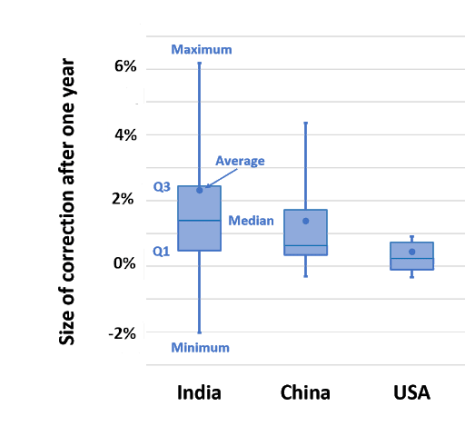
NOTABLY, A COMPARABLE ANALYSIS OF BP’S COAL CONSUMPTION VALUES FOR CHINA AND THE US SHOWS FEWER AND MUCH SMALLER CORRECTIONS.
 
Figure 2  -  Size and Variability of Corrections Made to Original BP Coal Consumption Growth Rates for India, China, and the USA
Size-and-Variability-of-Corrections-Made-to-Original-BP-Coal-Consumption
 
Figure 2 shows that over the 10 years to 2019, the values for India undergo sizeable corrections from their original reported values to those updated the following year, and growth rates in successive reports for the same years are poorly correlated (r2= 42). Those for China are changed less often and successive reported values are well correlated (r2 =.91). Figures for the US barely change at all and are highly correlated (r2 =.99).
 
Comparisons with Indian government data
BP’s documentation of its sources and methods sheds little light on the reasons that its India data undergoes these substantial, repeated revisions in subsequent years, which more often overestimate than underestimate the values subsequently published by official Indian government sources.
 
Until this year, BP used “mega-tonnes of oil-equivalent” (Mtoe) as its energy unit, changing this year to exajoules, but the Indian coal ministry reports tonnages, rendering direct comparison of absolute quantities difficult. Rates of change should, however, still be comparable. Even though BP’s reports use calendar years, while Indian data follows the financial year (April to March), this still leaves nine months of overlap between the two data sets, enough for a reasonable comparison. Of course, any large year-to-year changes between January and March will affect BP and Indian government data differently. This may well be the case for next year’s reports because of the COVID-19 pandemic, although its more dramatic economic effects have all occurred since April and should appear in both calendar year 2020 and FY21 data.
 
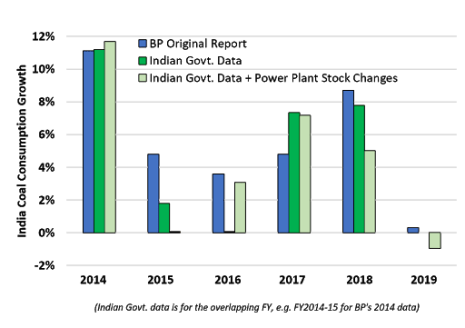
These differences aside, a comparison of the two is worthwhile. Figure 3 shows the original BP growth rate for each year since 2014, and the Indian government’s value for the corresponding periods (i.e. since FY2014-15). (A third data set adjusting the Indian data is also shown and explained below.)
 
For 2014 growth rates were high and extremely close between the two sources. For three recent years (2015, 2016 and 2018), BP reported higher – sometimes substantially higher – growth than the Indian government, while 2017 was an exception in which BP was below India’s data.
 
Figure 3. Coal Consumption Growth Rates From BP, Indian Government and Indian Government with Adjustments for Power Plant Stock Changes
Coal-Consumption-Growth-Rates-From-BP
 
The Indian government’s official estimates of coal consumption are published annually in its Energy Statistics report. It is impossible to verify these estimates from the constituent industry consumption data, as these figures are not all readily accessible and do not always agree. For example, the Energy Statistics document reported less coal being consumed for electricity generation than was reported by the Central Electricity Authority for 2016-17 and 2017-18, but more in 2018-19.
 
Fortunately, it is possible to confirm the estimates from first principles using other publicly available sources that are more up to date. This requires adding net imports to total domestic production from all public and private mines (adjusted for pithead stock changes, i.e. dispatched coal). The relevant values are available from other documents including the Provisional Coal Statistics and Coal Directory published by the Coal Controller, and they are extremely similar to the ‘Total Primary Supply’ reported in the latter.
 
These calculations yield an average error (calculated over the 10 years to 2018-19) of just 1.8 Mt (or 0.32% of the average 763.5 Mt official consumption over that period), and a standard error of measurement of only 1.1 Mt.
 
There are two useful features of this procedure, shown in Figure 3. It allows an estimate to be made of the latest year’s consumption for which the official figure is not yet available, by supplementing Government sources with published data of production and despatch from private mines.
 
We anticipate a decline of 1% for 2019-20 rather than BP’s marginal 0.3% growth for calendar 2019 – this year’s error may turn out to be quite modest. 
 
It also reveals an apparent omission in the official calculation – changes in coal stocks at power plants appear not to be taken into account. They are explicitly excluded “for simplicity” in calculating the Total Primary Supply. Although power plant stock changes will balance out in the long term, and in some years barely change from the end of the previous year, they can be significant. 
 
For example, when changes in power plant stock levels are included, actual consumption barely grew at all in 2015, compared to BP’s 4.8% estimate or the Indian Government’s 1.8%, while it grew more in 2016-17 than officially reported (3.1% vs. 0.1%). In each of the last two years these stockpiles have accumulated an additional 14 Mt. In consequence, the 8.7% growth BP reported for 2018 was, in fact, a less noteworthy 5.0% using Indian Government data and with the stockpile build-up not treated as consumption.
 
Just as single-year growth figures are highly prone to large oscillations and should be treated with considerable caution, the other summary statistic BP regularly provides, a 10 year average (5.7% in this year’s report) can be equally misleading for the opposite reason, as its timeframe is too long to have any real meaning given the speed of change in India’s power sector. A more useful time window might be three years, enough to stabilise the data without reaching back a full decade.
 
Investors, businesses and policymakers might, therefore, be better guided by the compound annual growth rate (CAGR) of 3.4% in actual coal consumption since 2016-17 than either 5.7% over 10 years or 2018’s incorrect, headline-grabbing and subsequently downgraded 8.7%.
 
Measurement accuracy matters. These statistics influence decisions, and BP’s recent tendency to overstate Indian coal consumption growth should be kept firmly in mind when making them.
 
Charles Worringham is an IEEFA guest contributor.
This article first appeared in The Wire       


If you believe an article violates your rights or the rights of others, please contact us.

Recent News

Friday, 10 July 20
GLOBAL SHIPPING EARNINGS FORECAST CUT AS SUPPLY SET TO OUTSTRIP DEMAND - MOODY'S
EBITDA forecast worsens, keeping outlook negative. We now expect the aggregate EBITDA of rated shipping companies to fall by around 16%-18% in 2020 ...


Friday, 10 July 20
SLOW RECOVERY IN TANKER RATES TO WEIGH ON BUANA LINTAS LAUTAN - FITCH RATINGS
Fitch Ratings believes that international tanker rates are likely improve after their sharp fall since May 2020, albeit at a slow pace. The weaknes ...


Wednesday, 08 July 20
MARKET INSIGHT - INTERMODAL
During the previous month, the dry bulk market witnessed an impressive increase in the BDI index that has reached 1800 points from 500 with a clear ...


Tuesday, 07 July 20
COAL INDIA WORKERS STRIKE CUTS OUTPUT BY 56%: OFFICIAL - REUTERS
A strike at Coal India Ltd cut production by 56% in the three days ending July 4 as workers oppose opening up coal mining to the private sector, a ...


Tuesday, 07 July 20
WHAT DOES THE PATHWAY TO A NET-ZERO ECONOMY LOOK LIKE FOR MINERS? - WOOD MACKENZIE
Wind, solar, electric vehicles, stationary storage and transmission are all central to achieving the Paris Agreement decarbonisation goals. &nb ...


   174 175 176 177 178   
Showing 876 to 880 news of total 6871
News by Category
Popular News
 
Total Members : 28,706
Member
Panelist
User ID
Password
Remember Me
By logging on you accept our TERMS OF USE.
Free
Register
Forgot Password
 
Our Members Are From ...

  • Tanito Harum - Indonesia
  • TRAFIGURA, South Korea
  • Jorong Barutama Greston.PT - Indonesia
  • Ind-Barath Power Infra Limited - India
  • Fearnleys - India
  • Meenaskhi Energy Private Limited - India
  • Georgia Ports Authority, United States
  • Grasim Industreis Ltd - India
  • Kepco SPC Power Corporation, Philippines
  • ASAPP Information Group - India
  • Bukit Makmur.PT - Indonesia
  • Maharashtra Electricity Regulatory Commission - India
  • Semirara Mining Corp, Philippines
  • Global Business Power Corporation, Philippines
  • Adani Power Ltd - India
  • Agrawal Coal Company - India
  • Orica Mining Services - Indonesia
  • Commonwealth Bank - Australia
  • Straits Asia Resources Limited - Singapore
  • Ministry of Transport, Egypt
  • Baramulti Group, Indonesia
  • TANGEDCO India
  • Interocean Group of Companies - India
  • Noble Europe Ltd - UK
  • Deutsche Bank - India
  • BRS Brokers - Singapore
  • Kumho Petrochemical, South Korea
  • WorleyParsons
  • Shenhua Group - China
  • World Bank
  • Surastha Cement
  • Platts
  • Bank of China, Malaysia
  • Arutmin Indonesia
  • PLN - Indonesia
  • Maybank - Singapore
  • Shree Cement - India
  • NTPC Limited - India
  • Altura Mining Limited, Indonesia
  • London Commodity Brokers - England
  • Timah Investasi Mineral - Indoneisa
  • The Treasury - Australian Government
  • Lanco Infratech Ltd - India
  • Singapore Mercantile Exchange
  • Runge Indonesia
  • Peabody Energy - USA
  • Dong Bac Coal Mineral Investment Coporation - Vietnam
  • IHS Mccloskey Coal Group - USA
  • Maruti Cements - India
  • Makarim & Taira - Indonesia
  • Mjunction Services Limited - India
  • J M Baxi & Co - India
  • Sarangani Energy Corporation, Philippines
  • Holcim Trading Pte Ltd - Singapore
  • Chettinad Cement Corporation Ltd - India
  • Malabar Cements Ltd - India
  • Bahari Cakrawala Sebuku - Indonesia
  • Dr Ramakrishna Prasad Power Pvt Ltd - India
  • IOL Indonesia
  • Trasteel International SA, Italy
  • Kobexindo Tractors - Indoneisa
  • Maheswari Brothers Coal Limited - India
  • Aboitiz Power Corporation - Philippines
  • Ceylon Electricity Board - Sri Lanka
  • Electricity Generating Authority of Thailand
  • Globalindo Alam Lestari - Indonesia
  • PowerSource Philippines DevCo
  • International Coal Ventures Pvt Ltd - India
  • PLN Batubara - Indonesia
  • Romanian Commodities Exchange
  • Truba Alam Manunggal Engineering.Tbk - Indonesia
  • Antam Resourcindo - Indonesia
  • Idemitsu - Japan
  • Russian Coal LLC
  • Japan Coal Energy Center
  • The State Trading Corporation of India Ltd
  • Marubeni Corporation - India
  • PNOC Exploration Corporation - Philippines
  • Mintek Dendrill Indonesia
  • Xstrata Coal
  • Manunggal Multi Energi - Indonesia
  • Kohat Cement Company Ltd. - Pakistan
  • RBS Sempra - UK
  • Iligan Light & Power Inc, Philippines
  • Kobe Steel Ltd - Japan
  • Indo Tambangraya Megah - Indonesia
  • Sical Logistics Limited - India
  • Samtan Co., Ltd - South Korea
  • Carbofer General Trading SA - India
  • Latin American Coal - Colombia
  • MEC Coal - Indonesia
  • SRK Consulting
  • APGENCO India
  • Cebu Energy, Philippines
  • Kideco Jaya Agung - Indonesia
  • South Luzon Thermal Energy Corporation
  • BNP Paribas - Singapore
  • Bank of America
  • Eastern Energy - Thailand
  • Coalindo Energy - Indonesia
  • Ince & co LLP
  • Britmindo - Indonesia
  • Directorate Of Revenue Intelligence - India
  • GNFC Limited - India
  • DBS Bank - Singapore
  • Oldendorff Carriers - Singapore
  • Sucofindo - Indonesia
  • Lafarge - France
  • Anglo American - United Kingdom
  • Jaiprakash Power Ventures ltd
  • OCBC - Singapore
  • Posco Energy - South Korea
  • U S Energy Resources
  • GAC Shipping (India) Pvt Ltd
  • Sojitz Corporation - Japan
  • Therma Luzon, Inc, Philippines
  • Panama Canal Authority
  • Cargill India Pvt Ltd
  • Malco - India
  • Permata Bank - Indonesia
  • ANZ Bank - Australia
  • Heidelberg Cement - Germany
  • Petrochimia International Co. Ltd.- Taiwan
  • ETA - Dubai
  • Global Green Power PLC Corporation, Philippines
  • CNBM International Corporation - China
  • Metalloyd Limited - United Kingdom
  • GMR Energy Limited - India
  • Asmin Koalindo Tuhup - Indonesia
  • TeaM Sual Corporation - Philippines
  • Freeport Indonesia
  • Karbindo Abesyapradhi - Indoneisa
  • Goldman Sachs - Singapore
  • SUEK AG - Indonesia
  • New Zealand Coal & Carbon
  • Energy Development Corp, Philippines
  • Berau Coal - Indonesia
  • Bayan Resources Tbk. - Indonesia
  • Banpu Public Company Limited - Thailand
  • San Jose City I Power Corp, Philippines
  • HSBC - Hong Kong
  • TGV SRAAC LIMITED, India
  • Reliance Power - India
  • Argus Media - Singapore
  • The University of Queensland
  • UOB Asia (HK) Ltd
  • Sree Jayajothi Cements Limited - India
  • Coeclerici Indonesia
  • CESC Limited - India
  • Gresik Semen - Indonesia
  • JPMorgan - India
  • Pendopo Energi Batubara - Indonesia
  • Samsung - South Korea
  • Billiton Holdings Pty Ltd - Australia
  • Pinang Coal Indonesia
  • Sinarmas Energy and Mining - Indonesia
  • Rashtriya Ispat Nigam Limited - India
  • Sindya Power Generating Company Private Ltd
  • GN Power Mariveles Coal Plant, Philippines
  • Platou - Singapore
  • Chamber of Mines of South Africa
  • Thailand Anthracite
  • Glencore India Pvt. Ltd
  • Price Waterhouse Coopers - Russia
  • Indonesia Power. PT
  • Cigading International Bulk Terminal - Indonesia
  • Asia Cement - Taiwan
  • Neyveli Lignite Corporation Ltd, - India
  • Indian School of Mines
  • Merrill Lynch Bank
  • Wilmar Investment Holdings
  • GB Group - China
  • Uttam Galva Steels Limited - India
  • Cement Manufacturers Association - India
  • Eastern Coal Council - USA
  • Medco Energi Mining Internasional
  • Indika Energy - Indonesia
  • Indian Oil Corporation Limited
  • globalCOAL - UK
  • Siam City Cement - Thailand
  • Electricity Authority, New Zealand
  • Barasentosa Lestari - Indonesia
  • Bukit Baiduri Energy - Indonesia
  • IBC Asia (S) Pte Ltd
  • White Energy Company Limited
  • UBS Singapore
  • OPG Power Generation Pvt Ltd - India
  • Power Finance Corporation Ltd., India
  • Bukit Asam (Persero) Tbk - Indonesia
  • Intertek Mineral Services - Indonesia
  • Parry Sugars Refinery, India
  • Humpuss - Indonesia
  • Binh Thuan Hamico - Vietnam
  • CCIC - Indonesia
  • Parliament of New Zealand
  • Cosco
  • Mitsubishi Corporation
  • World Coal - UK
  • Kalimantan Lumbung Energi - Indonesia
  • Meralco Power Generation, Philippines
  • Indian Energy Exchange, India
  • Mitsui
  • Independent Power Producers Association of India
  • Gupta Coal India Ltd
  • Vijayanagar Sugar Pvt Ltd - India
  • KPCL - India
  • Bangkok Bank PCL
  • AsiaOL BioFuels Corp., Philippines
  • Borneo Indobara - Indonesia
  • Attock Cement Pakistan Limited
  • Coaltrans Conferences
  • ING Bank NV - Singapore
  • Thai Mozambique Logistica
  • Vitol - Bahrain
  • Standard Chartered Bank - UAE
  • Deloitte Consulting - India
  • Infraline Energy - India
  • Bhushan Steel Limited - India
  • Adaro Indonesia
  • Riau Bara Harum - Indonesia
  • Planning Commission, India
  • Larsen & Toubro Limited - India
  • Filglen & Citicon Mining (HK) Ltd - Hong Kong
  • Savvy Resources Ltd - HongKong
  • Dalmia Cement Bharat India
  • Bhatia International Limited - India
  • Jindal Steel & Power Ltd - India
  • Central Java Power - Indonesia
  • TNB Fuel Sdn Bhd - Malaysia
  • KOWEPO - South Korea
  • Kapuas Tunggal Persada - Indonesia
  • Mechel - Russia
  • Geoservices-GeoAssay Lab
  • Asia Pacific Energy Resources Ventures Inc, Philippines
  • Coastal Gujarat Power Limited - India
  • Karaikal Port Pvt Ltd - India
  • SMG Consultants - Indonesia
  • Simpson Spence & Young - Indonesia
  • Coal Orbis AG
  • Gujarat Sidhee Cement - India
  • IEA Clean Coal Centre - UK
  • Mercator Lines Limited - India
  • Petrosea - Indonesia
  • Enel Italy
  • Inspectorate - India
  • Essar Steel Hazira Ltd - India
  • Directorate General of MIneral and Coal - Indonesia
  • India Bulls Power Limited - India
  • VISA Power Limited - India
  • Coal India Limited
  • PetroVietnam
  • Australian Coal Association
  • Rio Tinto Coal - Australia
  • Orica Australia Pty. Ltd.
  • Petron Corporation, Philippines
  • LBH Netherlands Bv - Netherlands
  • Thermax Limited - India
  • European Bulk Services B.V. - Netherlands
  • PTC India Limited - India
  • Indogreen Group - Indonesia
  • Coal and Oil Company - UAE
  • Africa Commodities Group - South Africa
  • Bharathi Cement Corporation - India
  • Merrill Lynch Commodities Europe
  • Indonesian Coal Mining Association
  • Asian Development Bank
  • Thriveni
  • Renaissance Capital - South Africa
  • Offshore Bulk Terminal Pte Ltd, Singapore
  • Global Coal Blending Company Limited - Australia
  • GVK Power & Infra Limited - India
  • Barclays Capital - USA
  • Ministry of Mines - Canada
  • Australian Commodity Traders Exchange
  • Energy Link Ltd, New Zealand
  • Indorama - Singapore
  • Vale Mozambique
  • Siam City Cement PLC, Thailand
  • Wood Mackenzie - Singapore
  • ACC Limited - India
  • Minerals Council of Australia
  • Tata Chemicals Ltd - India
  • GHCL Limited - India
  • Krishnapatnam Port Company Ltd. - India
  • Total Coal South Africa
  • Cardiff University - UK
  • Port Waratah Coal Services - Australia
  • Toyota Tsusho Corporation, Japan
  • bp singapore
  • Mitra SK Pvt Ltd - India
  • Formosa Plastics Group - Taiwan
  • KEPCO - South Korea
  • Kartika Selabumi Mining - Indonesia
  • Videocon Industries ltd - India
  • Vedanta Resources Plc - India
  • EIA - United States
  • Kaltim Prima Coal - Indonesia
  • Rudhra Energy - India
  • Leighton Contractors Pty Ltd - Australia
  • IMC Shipping - Singapore
  • The India Cements Ltd
  • CIMB Investment Bank - Malaysia
  • Tata Power - India
  • PetroVietnam Power Coal Import and Supply Company
  • EMO - The Netherlands
  • Thomson Reuters GRC
  • Ambuja Cements Ltd - India
  • SN Aboitiz Power Inc, Philippines
  • CoalTek, United States
  • Miang Besar Coal Terminal - Indonesia
  • Semirara Mining and Power Corporation, Philippines
  • Maersk Broker
  • SMC Global Power, Philippines
  • Central Electricity Authority - India
  • Bhoruka Overseas - Indonesia
  • KPMG - USA
  • Inco-Indonesia
  • Aditya Birla Group - India
  • Sakthi Sugars Limited - India
  • Ernst & Young Pvt. Ltd.
  • Pipit Mutiara Jaya. PT, Indonesia
  • Alfred C Toepfer International GmbH - Germany
  • Bangladesh Power Developement Board
  • McConnell Dowell - Australia
  • Cemex - Philippines
  • Economic Council, Georgia
  • Vizag Seaport Private Limited - India
  • Moodys - Singapore
  • Xindia Steels Limited - India
  • SASOL - South Africa
  • Ministry of Finance - Indonesia
  • Core Mineral Indonesia
  • ICICI Bank Limited - India
  • Thiess Contractors Indonesia
  • Gujarat Mineral Development Corp Ltd - India
  • Arch Coal - USA
  • Salva Resources Pvt Ltd - India
  • MS Steel International - UAE
  • TNPL - India
  • Edison Trading Spa - Italy
  • Bank of Tokyo Mitsubishi UFJ Ltd
  • Bulk Trading Sa - Switzerland
  • Star Paper Mills Limited - India
  • Qatrana Cement - Jordan
  • Jatenergy - Australia
  • Mercuria Energy - Indonesia
  • Credit Suisse - India
  • NALCO India
  • Madhucon Powers Ltd - India
  • McKinsey & Co - India
  • Tamil Nadu electricity Board
  • SGS (Thailand) Limited
  • Clarksons - UK
  • JPower - Japan
  • Gujarat Electricity Regulatory Commission - India